Spotlight on Professor Charlotte Wright
Professor Charlotte Wright, University of Glasgow, is a retired paediatric practice that supports the work with the long-standing Glasgow Lahore Children’s Hospital Twinning Programme partnership in Pakistan. She shares invaluable insights on global health, mutual learning and the life-changing impact.
Charlotte, can you tell us about your current roles in health in Scotland?
I retired from paediatric practice in 2022 but still retain an honorary role in the University as an academic. Since retiring I have continued to work with the Glasgow Lahore children’s hospital twinning programme and function informally as a sort of secretary and convenor for the organising group.
What inspired you to get involved in global health work and how did you start?
I volunteered during my gap year 50 years ago in India and Nepal and thus had an interest in the sub-continent from the start. During my medical training in Newcastle I did a research project studying the then newly arrived immigrant families from Pakistan and through that formed a friendship with a family in Lahore. When I moved to Glasgow and heard that the children’s hospital had just twinned with a hospital in Lahore, I was thrilled to get involved.
How did the partnership between the Children’s Hospital Lahore, Pakistan, and Royal Hospital for Children, NHS Greater Glasgow and Clyde, begin? What are its key aims, and what have been some of the opportunities and challenges for both partners?
The twinning programme between the Royal Hospital for Children in Glasgow with the Children’s Hospital in Lahore was instigated in 2001 and has been running successfully for 25 years. This twinning programme was originally an initiative of the Trust board who were seeking to increase their international profile. The Children’s Hospital and Institute of Child Health, (CHICH) Lahore, was then a newly opened, purpose-built specialist government hospital, serving both the city of Lahore (pop. 10 million) and the state of Punjab (pop. 60 million), Pakistan. The purpose of the twinning was the mutual education of the staff at Yorkhill and in Lahore.
This arrangement linked Scotland to an important emerging institution in one of the poorest countries in the world.
The partnership involves sharing practices and finding low-cost ways to preserve Pakistan’s breastfeeding culture. What have you learned from this and what mutual benefits have emerged from the partnership?
While the importance of breast feeding was already well understood, the practical threats to it were less recognised and training in practical skills was needed. We have come to recognise that breast feeding in Pakistan has recently come under the same threats that we faced in the UK 50 years ago, with the risk that they will also lose their strong breast-feeding culture. We thus aim to encourage our colleagues there to learn from Scotland’s past mistakes.
The twinning also increases staff knowledge and understanding of the cultural origins of Glasgow’s largest ethnic minority group, as well as enhancing relationships with the community. Glasgow’s families of Pakistani origin come mainly from the area around Lahore and have been generous in their donation to the twinning fund.
What achievements or successes from the Programme are you most proud of?
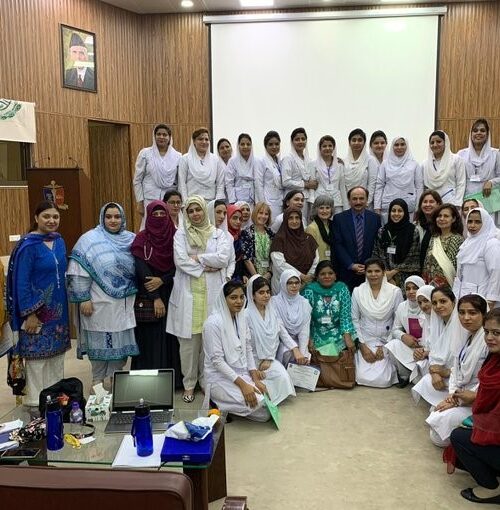
We are proud to have kept the twinning programme active now for 25 years and to have managed to bring two groups of staff from Lahore to Glasgow in the last 3 years alone. In November 2026, twelve of us will be travelling to Lahore to take part in a Silver Jubilee symposium to celebrate this, as well as to sign a memorandum of agreement with a large new Maternity unit in Lahore.
It was also a great thrill when our breast feeding team won the Global Citizenship Award at Scotland’s Health Awards in 2024.
How has your global health work influenced your career or professional development within the NHS?
Understanding of the specific issues that Pakistan origin families face with their children greatly helped my clinical work. For my academic work, my visits first advanced my understanding of the causes and management of undernutrition and the vital importance of breastfeeding, as well as how breast feeding was inherently vulnerable as countries like Pakistan transition to a more industrialised society.
What skills and qualities do you consider important in carrying out global health work?
An openness to difference, an understanding of the economic constraints on health care and an interest in understanding the fundamentals of good health care.
When you travel to Pakistan, what are the three items you never leave home without and why?
A non-crease outfit, sandals, and a head scarf in my hand luggage so that work can begin on arrival (and it usually does).
What has been the most challenging aspect of working in global health and how did you overcome it?
Those who cannot travel to Lahore can help greatly when visitors come from Lahore. These visitors need to be able to observe our practice and meet a wide range of clinicians. They also need a lot of practical support moving around Glasgow and finding their way within our confusing hospitals. If busy clinical clinicians can make time to meet and support these visitors, it makes a huge difference.
Do you have a memory from a global health trip that will stay with you forever – what made it so special?
Hard to pick any out – but having lunch at the Governor’s mansion was pretty remarkable, while meeting the then Minister of Health at a tea party was highly productive.
What advice would you give an NHS colleague who was thinking of becoming involved in global health work?
Find a good existing project for which you have relevant skills you can offer and work with it – you can’t do this alone.