Spotlight on Dr Niall Campbell
Dr Niall Campbell, NHS Borders, is helping transform healthcare through a long-standing partnership with St Francis Hospital in Zambia. He shares powerful insights on global health, mutual learning and the life-changing impact of collaborative care.
Niall, tell us your day job in NHS Scotland, the site you’re based and department that you work in.
I am a Consultant Psychiatrist working in the Borders General hospital Melrose in Liaison Psychiatry and I also work one day a week as a General Practitioner, something I have always valued and never wanted to give up. The mix of both has helped greatly in international health.
What inspired you to get involved in global health work, and how did you start?
The journey began with volunteering in India and Africa whilst at university. I saw first-hand the poverty, lack of access to health care and unnecessary death from both tropical diseases and non-communicable diseases. I witnessed how making even small changes could have life changing consequences and I wanted to be part of that. I decided to complete the diploma in Tropical medicine in Liverpool where I met Professor Eldry Parry. He asked if I would be willing to review projects for THET in Ethiopia; I was the Lead for chronic disease as a GP at the time in Scotland.
How does the twinning partnership with St Francis Hospital work in practice? What are the main aims and challenges for both partners?
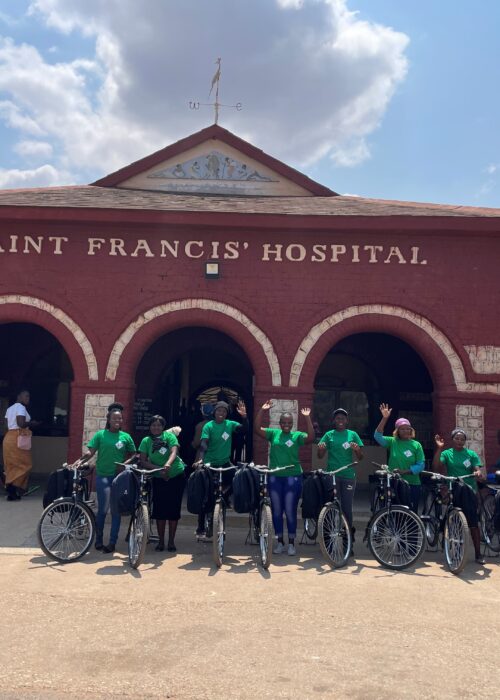
The formal partnership often described through the supporting charity The Logie Legacy – stems from a long-standing link between NHS Borders (which includes Borders General Hospital) and St Francis’ Hospital. The link began in the early 1990s and has developed gradually over many years.
In practice, it involves Scottish healthcare volunteers – including doctors, nurses, midwives and pharmacists – providing clinical support and skills training across areas such as maternity care, paediatrics, HIV services and TB control, with a focus on sustainable knowledge transfer rather than short-term cover. The partnership also tackles wider public health infrastructure, including work to improve water and sanitation systems critical to infection prevention. The main aims are to strengthen clinical services, build local workforce capacity and foster genuine mutual learning between both institutions. The key challenges include funding shortfalls, infrastructure constraints, workforce shortages and ensuring that volunteer expertise is matched to the hospital’s most pressing needs – with communication across the partnership being an ongoing priority, partly addressed through the appointment of a dedicated local liaison.
What have you learned from your colleagues in Zambia about education, service delivery, and patient experience? What mutual benefits have emerged from the partnership?
Working with colleagues in Zambia has really reshaped how I think about education, service delivery and patient care. I’ve learned the value of strong clinical skills when resources are limited — careful history-taking, examination and pragmatic decision-making become central. Education there is closely linked to real service needs, which reinforces that training must be practical, relevant and sustainable. I’ve also been struck by the teamwork and adaptability of staff, and by how community and family are deeply integrated into the patient experience.
The benefits have been genuinely mutual. Colleagues at St Francis’ gain access to mentoring, training and quality improvement support, while Scottish staff return with improved clinical confidence, leadership skills and a renewed focus on patient-centred care. The partnership has strengthened professional development on both sides and built long-term relationships based on shared learning rather than one-way support.
From your experience what skills do you consider important in carrying out global health work?
From my experience, effective global health work depends less on technical expertise alone and more on a combination of professional and personal skills.
First, cultural humility is essential — recognising that you are entering someone else’s system and that local colleagues are the experts in their context. Listening well and being willing to adapt is critical.
Second, strong clinical and problem-solving skills matter, particularly the ability to work safely and pragmatically in resource-limited settings. This includes being comfortable with uncertainty and focusing on what is feasible rather than ideal.
Third, communication and teaching skills are key. Global health partnerships are most sustainable when they prioritise knowledge exchange and capacity building rather than short-term service delivery.
Fourth, flexibility and resilience are important. Plans change, resources fluctuate, and systems can be stretched — so adaptability and emotional resilience are vital.
Finally, teamwork and relationship-building underpin everything. Trust, mutual respect, and long-term commitment are what turn a project into a genuine partnership.
In short, global health work requires humility, adaptability, strong communication, and a commitment to sustainable, collaborative practice. Remember to listen then act, always involve people at a local level if you want local ownership of projects, the key to success.
When you travel to Zambia, what are the three items you never leave home without – and why?
Journal (notebook) to document experiences, reflect on what I have seen and heard, memorable moments and quotes. Contacts I’ve met along the way.
Phone – whilst I’d like to say I keep it at home, however, it now provides me with all my contacts, internet access for last minute presentations, allows me to look up local guidelines etc, keeping in touch with friends and family back home as being away can get lonely and it provides an opportunity to debrief from the challenges of the day. It’s my torch, camera (to capture memorable moments), notebook and a way to access money even in rural areas.
Tea & Abernethy biscuits – of course you’ll be able to get tea but this is a little bit of home and one of my comforts after a long day. A bit of self-care.
What benefits do you feel you have gained from being involved in your twinning partnership?
Being involved in the twinning partnership between Logie Legacy and St Francis Hospital has been incredibly rewarding on multiple levels. Professionally, it has broadened my perspective on mental health care in resource-limited settings and challenged me to think creatively about service delivery, which in turn has inspired improvements at home. Personally, it’s strengthened my leadership and collaboration skills — working closely with colleagues across cultures has taught me the importance of listening, adaptability and building trust.
Perhaps most importantly, the partnership has reinforced the value of shared learning: it’s not a one-way exchange. The innovations and resilience of the St Francis team have influenced how we approach challenges in Scotland, while our support helps them develop sustainable solutions. Seeing tangible improvements in patient care, staff development, and community engagement has been deeply motivating and reminds me why I do this work.
What benefits do you feel your Health Board and/or colleagues have gained from your involvement in global health work?
Firstly, it has helped foster a culture of shared learning and innovation: insights from resource-limited settings have inspired us to think differently about service delivery, efficiency and patient-centred care here in Scotland.
Secondly, it has strengthened collaboration and leadership across teams. Colleagues who have participated in exchanges or workshops often report renewed motivation and fresh ideas, and the partnership encourages a sense of pride in contributing to meaningful, global impact.
Finally, it has enhanced our organisational reputation and networks. The Health Board is seen as proactive in supporting sustainable mental health, public health, gender-based initiatives internationally, which opens doors for research, knowledge exchange and future partnerships. In short, it’s not just about what I gain personally — it’s about creating lasting value for the teams and organisation I work with.
Tell us about a memory from a global health trip that will stay with you forever – what made it so special?
This involves a patient in the local community whom I had previously treated at a missionary hospital in Africa. I was told about a young man with severe mental illness who had been tied up in a cowshed, unable to work because his family believed he was possessed. Hearing this, I asked for him to be brought to the hospital and I was met with resistance by church leaders and local healers.
Once there, he was unchained, bathed, fed, clothed and started on treatment for psychosis related to HIV infection. Over the course of several months, he recovered remarkably. In that time I met with the church leaders and local healers allowing them to be part of the healing and holistic care, showing them that I didn’t have all the answers but together we could create change. What made it truly special was seeing him not only regain his health but also his dignity and role in the community. He became one of our first peer mentors, helping to dispel myths about mental illness, became a paid volunteer and eventually was able to marry and fully reintegrate into community life.
That experience stays with me because it embodies everything I value in global health work — restoring hope, challenging stigma and seeing how the right care can transform an individual’s life and ripple out to benefit the whole community.
What advice would you give an NHS colleague who was thinking of becoming involved in global health work?
I’d encourage them to get involved — but to do it thoughtfully and sustainably. Global health work is most valuable when it’s based on partnership, mutual learning and long-term commitment rather than short visits or one-way teaching. I’d suggest linking with an established programme or twinning partnership so the work is locally led and continues after you leave. Sometimes people can be hampered from getting involved as they think they need experience volunteering or specialist knowledge in Tropical diseases – this doesn’t have to be the case. We bring a wealth of personal and professional experience, as do the people in the countries we become involved with.
I’d also advise them to go with humility and curiosity. You learn as much as you contribute — often more. Working in resource-limited settings strengthens clinical judgement, creativity and teamwork, and those skills transfer directly back into NHS practice.
Finally, I’d say be realistic and prepare well: understand the context, respect local expertise and think about how your involvement will benefit both sides. When done well, global health work is incredibly rewarding and can energise your practice, your leadership and your sense of purpose, not just in the short term but for the rest of your career and beyond.
Is there anything else you’d like to add about your global health work or the twinning partnership?
I’d add that this work is not just a personal commitment — it’s part of my leadership role as NHS Borders Global Health Lead Champion and as Chair of Logie Legacy. I see the twinning partnership with St Francis Hospital as a practical example of how global health collaboration can deliver mutual benefit, workforce development and sustainable mental health improvement.
I’m particularly keen to see the partnership continue to grow in alignment with the Scottish Government’s international health strategy and its commitment to working with Zambia. There is a real opportunity to strengthen links between government, Health Boards and trusted local partnerships on the ground — moving from individual projects to more structured, long-term collaboration.
My aim is to help build that bridge — ensuring the work remains locally led, ethically grounded and sustainable — while supporting staff development, reducing stigma around mental illness and improving care in both settings. The work is not limited to mental health but I believe it underpins all other health. I see this as long-term relationship building, not short-term intervention, and I’m committed to helping it mature and expand responsibly.
Finally “Never doubt that a small group of thoughtful, committed people can change the world; indeed, it’s the only thing that ever has.” — Margaret Mead