Spotlight on Dr Mudher Al-Khairalla
Dr. Mudher Al-Khairalla, NHS Tayside, has dedicated his career to bridging healthcare gaps between Scotland and Iraq. From setting up state-funded hospitals to training the next generation of respiratory specialists, his work exemplifies the power of global partnerships. We spoke to Mudher about his journey, challenges and what global citizenship means to him.
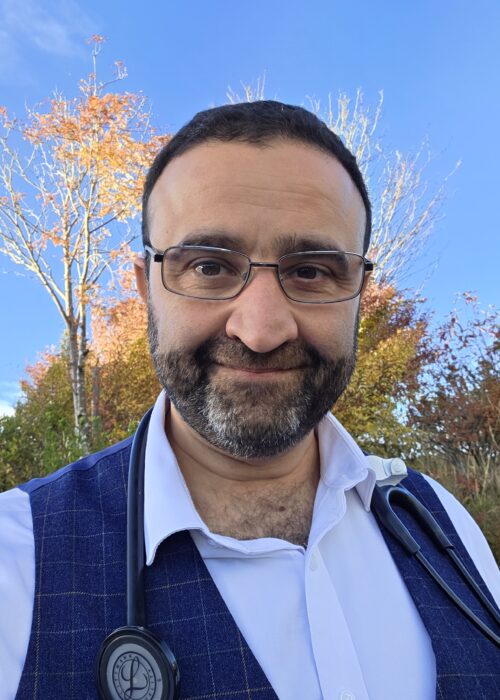
Mudher, please tell us your day job, the site you’re based and department that you work in NHS Scotland?
I am the clinical lead and a consultant in Respiratory and Internal Medicine mainly based at Perth Royal Infirmary, NHS Tayside. I also currently hold a special interest in pleural diseases. It’s a busy role and fortunate to have supportive colleagues and management to help me serve the local population the best way I can.
How did you first get involved in global health work?
Being of mixed heritage (British/Iraqi) it has always been a passion of mine to contribute, in what little I can, to health/education inequity. I started to offer teaching sessions and clinical work in Iraq when the previous regime was toppled in 2003.
Please tell us what area of global health you are involved in, which partnership country and organisation/affiliation you work with?
Global Premiere Training Institute – Most of my work includes clinical work and teaching in Scotland and Iraq. But I also chair higher internal medicine exams across the globe, including countries such as India, Pakistan, Malaysia, Jordan, UAE among others.
I travel on rolling 6-week rota to Iraq, working for 3-weeks at a time. The day job includes: as training programme director, of the Iraqi Respiratory Board, teaching ward round and formal specialty teaching at the state funded Nasiriyyah Lung Centre at Nasiriyyah teaching hospital in ThiQar province southern Iraq. This is followed by a brief break and then teaching undergraduate medical students at Al-Ayen Iraqi University Medical College, at which I am chief of medicine. Then I take a break & complete the evening by attending ThiQar Lung Diseases Institute as a consultant. On a typical ‘watch’ that I oversee, will include more than 100 patients per day and many undergraduate and postgraduate trainees.
Your global citizenship work has seen you set up two state-funded hospitals in Iraq with a specialised department in respiratory medicine. Tell us about the country you returned to and the local area and access to health care for the local people, and the main challenges you faced setting up the hospitals.
I helped set up a state funded hospital which is twinned and partnered with a private one. They are tertiary centres, Public-Private Partnership that covers a catchment area of 2.5 million people and the southern region, approximately 15 million people.
Your work has now changed to a training role since you moved back to Scotland. Tell us about those changes and what it’s like doing global health work from Scotland.
I am fortunate in that I am able to maintain aspects of my work in Iraq to date, and the work I undertake in the UK as a substantive consultant and senior lecturer at the university of Dundee has helped network and create an interface in education, training and discussion of complex clinical cases.
For NHS staff who want to participate in global health work, what three skills do you consider important, and what advice would you give them?
Skills 1. Adaptability, 2. Tenacity and 3. Humility. My main advice is to start somewhere, with something small and enjoy the experience.
What benefits do you feel you have gained from being involved in your partnership in Iraq and what benefits do you feel your Health Board and/or colleagues have gained from your involvement in this work?
Confidence in processing complex cases in an effective and safe way. Understanding of what the strengths and weaknesses of each system are and ways in which one can think critically to trial bespoke ideas that may serve people better.
You’ve been recognised as a finalist for Scotland’s Health Awards, Global Citizenship Award 2023 and won the STAR Tayside Global Citizenship Award in 2022. What did this recognition mean to you?
I had not expected this. It meant a lot to me, my family and colleagues, who are the unsung heroes in this adventure.
Finally, tell us about a memory from your global health work or a trip that will stay with you forever?
The outpouring of sympathy and support when I faced death threats due to a brief period of anarchy in Iraq in 2019.